Showing posts with label Civil War. Show all posts

Friday, July 4, 2014

The Fiery Trial by Eric Foner - Book Review


Eric Foner serves as the DeWitt Clinton Professor of History at Columbia University. Perhaps even more noteworthy, Foner is one of a handful of authors to have been the recipient of the Bancroft and Pulitzer Prizes in the same year.1 His latest book, The Fiery Trial: Abraham Lincoln and American Slavery, gives a rare glimpse at Lincoln amidst the backdrop of slavery. Foner aims to elucidate the private Lincoln’s thoughts on slavery, from his numerous speeches and correspondence, and locate the Great Emancipator on the broad spectrum of antislavery thought. Over one hundred and fifty years after his death and the end of the American Civil War, many Americans are blinded by the near-deism and God-like elevation of Lincoln as the liberator of one eighth of the population in 1863. Although they will not gain an understanding of Lincoln the person, readers might be surprised to learn about the true aspects of Lincoln’s feelings on race and slavery, most especially his gradualistic emancipation policies, compensated emancipation, and colonization.In Lincoln’s evolving theories on slavery, Foner makes clear that he was always against the institution of slavery itself. “Lincoln criticized slavery as unwise and unjust” at a time when antislavery thought, and especially abolitionism, was unpopular in his part of the country.2 In fact, Foner correctly argues that Lincoln’s refusal to see the expansion of slavery in the Western United States led to the outbreak of the Civil War.3 However, Lincoln could hardly be called an abolitionist: for a major portion of his political career, Lincoln was against black suffrage. Despite Lincoln’s shortcomings as a true abolitionist, Foner gives credit to Lincoln’s evolving views on slavery and persistence that the institution must end.
With heavy influence from Henry Clay, his political idol, Lincoln was a proponent of gradual emancipation. Foner explains that “during his first two years of the Civil War, he would present for the approval of slaveholders a number of plans for gradual, compensated emancipation.” For Lincoln, gradual emancipation was also tied to apprenticeship. Foner contends that Lincoln held on to his ideas of gradual emancipation up until the issuance of the Emancipation Proclamation, and even after January 1863, he would occasionally speak of gradual emancipation and apprenticeship to ambassadors and cabinet members.4The second major premise of Lincoln’s views on slavery is his plan of compensation to the slaveholders, with major focus on border states. Foner especially details Lincoln’s presidency in 1862 as sincere confirmation of the compensated emancipation plan. “Lincoln asked Congress to adopt a joint resolution pledging to provide financial compensation to any state that enacted a plan for the gradual abolishment of slavery.”5 Even though compensated emancipation had been successful elsewhere, Lincoln was unable to carry out his compensation plan.Again drawing from Henry Clay, Lincoln took up the plan of colonization. Foner contends that an early connection with colonization also helped to inspire an almost permanent advocacy of colonization. After representing the Anthony Bryant family in a legal case in 1847, the Bryant family eventually relocated to Liberia. 6 It was not until after the Emancipation Proclamation had been issued that Lincoln publicly abandoned his efforts to colonize ex-slaves in Africa or South America. 7 Foner paints Lincoln’s colonization efforts as the belief that remained unchanged until the end of the Civil War neared. With much naiveté, Lincoln had a firm belief that colonization was a viable solution once emancipation was granted.
Briefly, Foner’s point that Lincoln was racist, even mildly so, falls short of full proof. Foner indicates that Lincoln used the word “niger” and “darkie” in everyday language. However, this alone can not prove that Lincoln was racist.8 That type of terminology would have been standard speech in Lincoln’s time. Foner also states that Lincoln did not embrace racism but also did not condemn it either, a thought that can be made in reference to anything. It is simple to remain unconvinced that Lincoln was racist based on this point alone. Also, Lincoln’s treatment of his servant, William Johnson, cannot fail to be mentioned. Not only was this servant black, but Lincoln signed for several recommendations and paid for Johnson’s funeral expenses. Had Lincoln been severely racist, it is very hard to imagine he would have accorded Johnson these respectful measures. This is the only area Foner falls short in his biography of Lincoln’s views on slavery. In his Preface, Foner admits that The Fiery Trial would not be a biography of Lincoln, but without knowing the personal Lincoln it is hard to understand his slavery positions.
Like a wave extending from Lincoln’s Emancipation Proclamation and his Gettysburg Address, after Lincoln’s death so carried on the emancipationist vision of the Civil War as laid out in David Blight’s Race and Reunion: The Civil War in American Memory. Blight argues that in the Gettysburg Address Lincoln “seemed to see fitfully that rebirth would be rooted in the challenge of human equality in a nation.”9 Memory of the Civil War would have been drastically different had Lincoln not been assassinated. As Andrew Johnson took over the Presidency and issued his own Reconstruction policies that were lenient to Southern former slaveholders, many Northerners and former slaves used the emancipationist memory as something that could have been. Pushed aside were Lincoln’s gradual emancipation and colonization efforts, and instead to be remembered was his greatest accomplishment: the Emancipation Proclamation. Emancipation would be Lincoln’s lasting legacy.

EricFoner.com. “Eric Foner.” accessed June 23, 2014, http://www.ericfoner.com/index.html. 
Foner, The Fiery Trial, 26.Ibid., 165.
Ibid., 258. 
Ibid., 195. 
Ibid., 47.
Ibid., 258. 
Ibid., 120.
9 Blight, Race and Reunion 13-14. 

Mothers of Invention: Women of the Slaveholding South in the American Civil War


Drawing on letters, diaries, and poetry from Southern women belonging to the elite class of slaveholders, Faust attempts to examine how these women were transformed during the Civil War. At the onset of war dainty ladies were happy to send the menfolk off to battle, little expecting four long years of war and personal hardship. As the war raged on, elite southern women were forced to take up the slack of their missing husbands, sons, and brothers. Women came to know a different social order, one without their husbands and sons, and for single ladies, an entire life without men. Faust pens the biography of high society Southern women during the Civil War years to give historians and readers an idea of the transformations their lives went through in just over four years.
 Anyone searching for understanding of what women in the slaveholding class of the South during the American Civil War experienced would find use of this book. While interesting, Mothers of Invention leaves the reader feeling that something important was missed in Faust’s portrait of Southern slaveholding women. As president of Harvard University, Gilpin Faust’s other books specializing in the Civil War South include James Henry Hammond and the Old South: A Design for Mastery and The Creation of Confederate Nationalism: Ideology and Identity in the Civil War South.1
 With men running off to fight, women wanted to feel useful and needed something to keep them busy. Faust points to the desire of many women to find productive use of their time. In a precursor to the Reconstruction years and memorializing Civil War soldiers and Southern history, most elite women felt that they could contribute to the war effort in some way. According to many, teaching was a natural fit. The Augusta Daily Constitutionalist boldly proclaimed that “Women are peculiarly fitted, naturally and morally, for teachers of the young.” Faust argues pressingly that the advent of female teachers spurred a movement for the reform and upgrading of women’s education. Although there were educated women in Southern aristocracy, it was noted that the education of women was not substantial enough, particularly if they were to educate men.2
In general, women’s entire lives were turned upside down when their men left to defend the South. From managing plantations and droves of slaves, to adjusting to life across the board without their partners, women at first looked at the change in their lives as badges of honor. With capital and investments to sustain upper-class families, Faust contends that the effects of the mass exodus of so many men was delayed and less direct.3 However, as the Civil War would eventually come to an end women were beyond ready for their men to return home. Faust notes from the diaries and letters of many Southern women the entreaties for the men to return. A Texan wrote her husband, “The truth is . . . you must come home.”4
Mothers of Invention fails to mention another group of “Women of the Slaveholding South in the American Civil War.”: the slave women themselves. Living right alongside white women during the Civil War were female slaves. The experiences of these slave women during this period would have changed greatly, just as significantly as those of the slaveholding women. Surely their ‘inventiveness’ would have been just as great as white women of the ruling class. Without the capital and investment Faust notes of white women, slave women and newly emancipated women would have faced even greater challenges. The mention of Lizzie Neblett and her repurchase of her own clothing from a slave does not begin to shed light on the changing lives of slave women.5
David W. Blight’s Race and Reunion: The Civil War in American Memory provides readers with three leading memories of the Civil War. Significantly for Mothers of Invention is the reconciliationist vision that extolled the dedication of Union and Confederate soldiers without entertaining discourse on the causes and motives of the Civil War, largely promoted by women. With their self-aggrandizement during The War, women felt they could also contribute something after the Civil War. Women felt they had suffered right alongside their men, and knew acutely the heroism and bravery of their men. Women, especially the female group, United Daughters of the Confederacy, were adept at raising money to memorialize the men who had fought in the Civil War. Blight posits that the United Daughters of the Confederacy even tried to control historical interpretation of the Civil War by managing student textbooks. 6 “As guardians of piety, education, and culture,” women channelled their war experiences into Reconstruction activism.7
A transformation signifies something that was, but has now been changed. Mothers of Invention does not look back at the women and the Civil War years after time had passed. Did the feelings and experiences these women experience carry on throughout the years of reconstruction? What were the significant aspects of transformation after the war in their relationships with men? Did the women bring back their beloved fashions? Faust alludes to soldiers experiencing post-traumatic stress but for all the reader knows it was business as usual for the Southern women after the men returned. Reflections along this vein would have allowed the reader to make a better conclusion on the effect of the American Civil War on women of the upperclass South. 

Harvard University. “Catherine Drew Gilpin Faust.” accessed June 9, 2014, http://www.harvard.edu/ president/biography.
Faust, Mothers of Invention, 83-84. 
Ibid., 32.Ibid., 241.
Ibid., 222.Blight, Race and Reunion, 273. 
Ibid., 273.

James Henry Hammond and the Old South: A Design For Mastery - Book Review


Drew Gilpin Faust provides the definitive account of James Henry Hammond’s life. Instead of the subtitle A Design for Mastery, Gilpin Faust could have chosen Great Expectations. Hammond’s father had great expectations for him as a young boy, and Hammond had extreme great expectations for himself. Born into humble beginnings, Hammond would go on to marry well and become one of the wealthiest planters of the Old South in South Carolina. Hammond expected great things of himself and of his surroundings based on his ability to control them. Attempting to realize these great expectations, Hammond became a leading political leader of South Carolina as governor, and the United States as senator. Hammond’s father instilled in him at an early age that he would be ambitious and successful. To do so, Hammond would need to master every aspect of his life. But, Hammond’s inability to completely master himself and attain his lofty ambitions would eventually contribute to his death. As Hammond died, so did the Old South.
 Anyone searching for understanding of the rich planter class of the Old South would be fascinated with this book. Hammond’s attention to detail regarding his plantations and personal life gives clarity into the Old South period of American history. Gilpin Faust seamlessly guides the reader through Hammond’s life and career, leaving the reader to hate Hammond on one page, and cheer him on the next. As president of Harvard University, Gilpin Faust’s other books include Mothers of Invention: Women of the Slaveholding South in the American Civil War and The Creation of Confederate Nationalism: Ideology and Identity in the Civil War South.1
Gilpin Faust uses communication between Hammond and his children as primary evidence of his controlling nature. With his children dependent upon him for financial assistance, “Hammond employed his financial authority to reinforce his psychological dominance.”2 Hammond’s children were never able to feel like adults because of Hammond’s need to control. Gilpin Faust convincingly maintains that Hammond wanted his children to be dependent upon him, while at the same time attempting to make their own way.3 For instance, when Hammond reached his fifties, he was ready for his sons to take over the plantation. When the Civil War broke out and Hammond’s eldest son, Harry, enlisted for the Southern cause, Hammond complained at all the plantation work Harry would be neglecting.4 Hammond did not stop there. In a particularly memorable passage, Gilpin Faust transcribes a portion of a letter Hammond had written to his brother about controlling their own bowel movements.5 In Hammond’s world, every action, involuntary or not, could be controlled.
Gilpin Faust explains Hammond’s desire to master his surroundings using his own detailed plantation records. Hammond was a meticulous record keeper, especially when it came to his plantations. In his plantation journals, Hammond tracked crop output, crop experiments, slave efficiency, and agricultural economics. It is easy for the reader to comprehend Hammond’s attempts at mastery solely based on Gilpin Faust’s use of the Hammond plantation journals. The Appendix may also be referenced for better understanding of Hammond’s plantation records.
Minute record keeping alone would not satisfy Hammond in his quest for absolute dominance in all aspects of his plantation, he also needed control over the particulars of the lives of his slaves. Shortly after taking the reins of Silver Bluff plantation Hammond set about exerting his dominance over his slaves. In order to prevent religion from becoming a vehicle for slave revolt, Hammond ordered black religious meetings stopped. Gilpin Faust argues that part of Hammond’s plan of exerting omnipotence over his slaves was taking away their religious activities, but another part was showing his slaves that he was their benefactor. So while black religious meetings were stopped, Hammond allowed white clergy members to minister to the blacks, albeit in a very controlled environment.6
In all of his efforts of mastery, Gilpin Faust points to one area Hammond was unable to control: his own sexual desires. Hammond carried on a type of concubinage relationship with two of his slaves. He even admitted to fathering several children with these two women, who also happened to be mother and daughter.7 In typical Hammond fashion, when his wife, Catherine, found out about the affairs and demanded the two slaves sold, Hammond controlled the situation and would not allow their sale.8
! In another example of Hammond’s inability to control his sexual desires, Gilpin Faust describes the mishap with Hammond and his four teenage nieces, Harriet, Catherine, Anne and Caroline Hampton.9 While Hammond admitted the indiscretion, the
repercussions to his political career were severe, not to mention his exile from his extended Hampton family. Although Hammond did not live during the Reconstruction years after the Civil War, one of Blight’s categories of historical memory in Race and Reunion is still applicable to Hammond’s life: Hammond was a virulent white supremacist. With his desire to become a man of literature in the Old South, Hammond wrote proslavery tracts. Here, “Hammond would justify slavery in terms of a hierarchical ideology that called not only for the dominance of white over black but for the preeminence among whites of men of intellectual endowments like his own.”10 Not only did Hammond believe whites should dominate blacks, but that whites, especially whites in the Southern aristocracy class like himself, were superior to blacks. Hammond took this dominant mindset to Europe during a nearly two year respite trip. Accustomed to an army of slaves to attend to his every need, Hammond was impatient with European servants and the free-labor system. Events climaxed into Hammond assaulting a servant and spending a night in a Belgian jail, in the “midst of all the felons.”11James Henry Hammond and the Old South is a great biography of one of the Old South’s true sons. James Henry Hammond exemplifies everything about the elite Old South: wealthy, intelligent, white supremacist, and a slave owner. Gilpin Faust provides readers with a riveting first-hand account of not only the life of Hammond, but of the true picture of elite Southerners in the years leading up to the Civil War. 

Harvard University. “Catherine Drew Gilpin Faust.” accessed June 9, 2014, http://www.harvard.edu/ president/biography.
Gilpin Faust, James Henry Hammond, 320. 
Ibid., 325.Ibid., 367.Ibid., 376.
Ibid., 73-74. 
Ibid., 87.Ibid., 316.Ibid., 241.

10 Ibid., 279. 
11 Ibid., 199. 

Friday, May 23, 2014

History 5373 - Civil War and Reconstruction

History 5373 - Civil War and Reconstruction
Summer I - 2014

Race and Reunion: The Civil War in American Memory, by David W. Blight
Blight, David W. Race and Reunion: The Civil War in American Memory. Cambridge: Belknap Press, 2001.
Book Review
Before the American Civil War even ended people looked for meaning in the dead and the living. David W. Blight’s Race and Reunion: The Civil War in American Memory provides readers with three leading memories of the Civil War: (1) the reconciliationist vision that extolled the dedication of Union and Confederate soldiers without entertaining discourse on the causes and motives of the Civil War, (2) the white supremacist vision that would minimize the role of race and slavery as a cause of the war and justification of the South’s social order before the war, and (3) the emancipationist remembrance that struggled to provide the rebirth of the nation with black citizenship and black equality. These three visions would propel Americans out of the Civil War and Reconstruction years to well into the nineteenth century. 
Blight relies heavily on poet Walt Whitman for the root of reconciliationist thought and ideology. Serving the wounded and dying of both armies, Whitman became the epitome of the sectional reconciler: understanding of soldiers’ death and their need to mourn, commemorate, and memorialize all the death on both sides.(1) In fact, Blight credits Whitman with building and illuminating “the literary avenue to reunion.”(2) After the Civil War many Americans wanted to forget the Civil War and its causes. Sectional reconciliation would allow both the North and South to come together and rebuild the nation. Just days after the surrender at Appomattox the first mutual ceremony involving a parade and the decoration of the graves of the dead with spring flowers took place. (3) What was known then as ‘Decoration Day,’ would later become known as Memorial Day, spread throughout the North and South as a way to mutually sympathize and respect the dead of both sides. (4) Veterans themselves also needed a way to recollect and reunite. With a wave of fraternalism, soldiers’ reunions became a way for veterans to reminisce and express their shared trauma. These aging veterans were able to reconcile themselves together through commemoration of a common valor shared in the Civil War. 
Even with themes of reconciliation abounding in American culture and literature, Blight maintains that the white supremacist vision of the Civil War and Reconstruction took the place of the reconcilationist vision, especially in the South. In the beginning, Southerners had begun to remember the Civil War as the Lost Cause. The Lost Cause was the voice of reconciliation, but equally demeaned blacks, and crushed black adult’s rights. (5) The three elements that maintained prominence in the Lost Cause were the movement’s effort to write and control history, its use of white supremacy, and the place of women in its development. (6) And so, what began as a white counterrevolution during Reconstruction became the genesis of the Ku Klux Klan in 1866. (7) The Lost Cause developed into the South’s narrative of racial victory. (8) Specifically using the literary works of Thomas Nelson Page, Blight proves his point about the white supremacist vision. Because of Page’s fiction that depicted the plantation legend and agrarian virtue, he became a literary superstar for the South.(9) Undoubtedly, one of the most racially biased figures Blight utilizes as an example of white supremacy and black hatred is Mildred Lewis Rutherford of Athens, Georgia. As historian general of the United Daughters of the Confederacy, Rutherford was able to collect a massive library of the racist underworld and Lost Cause ideology. With essays, photographs and postcards, Rutherford filled scrapbooks with examples of lynchings, ‘loyal’ ex-slaves and Klansmen. (10) The white supremacist vision took deep root in the South, eventually leading to the Jim Crow era of Southern society and becoming ground zero for the Civil Rights Movement in the 1960s. 
According to Blight, lingering in the background of both the reconciliationist and white supremacist visions stood the emancipationist remembrance of the Civil War and Reconstruction. Led by abolitionists like Frederick Douglass, the narrative of black Civil War memory was of a national rebirth and redefinition. (11) In a lengthy chapter, “Black Memory and Progress of the Race,” Blight cites Booker T. Washington as leading the rhetoric on the “progress of the race” and the race problem. (12) Washington’s “progress of the race” theory viewed the beginning of of Negro life in America as the end of slavery, along with blacks emerging from slavery as a Christian people. (13) Washington pushed an “accommodationism” society, where blacks should demonstrate gratitude for past lives laid down and sacrifices made. (14) Blight goes on to paint Washington as the ultimate apologizer for the black race, both for their color and inability to live up to standards set by whites. Emancipationism fused the rebirth and redefinition led by Douglass and the accommodationism vision led by Washington.
As the 50th anniversary of the Civil War loomed, Americans had seen economic and social change, along with sectional reconciliation. (15) At the supremely segregated reunion at Gettysburg in 1913, Blight points out that whites took the memory of the Civil War and Reconstruction from blacks, leaving blacks as outsiders looking in - a trend that would continue throughout the nineteenth century. (16)
Blight’s use of contemporary literature and resources is impressive; however, Race and Reunion is not easy to read, in part because of the frequent borrowing from other sources. Blight could have had a greater eye for detail, as in his frequent omission of a closing parenthesis. Even more detracting is the transposition of the abbreviation for the Son’s of Confederate Veterans as SVC instead of SCV. (17) Other than Presidential elections in the two decades following the Civil War does Blight reference the political climate. Perhaps anticipating such criticism, Blight points out in his prologue that he does put considerable attention on Reconstruction politics while leaving out “late-nineteenth-century presidential politics.” (18) This omission of nineteenth century political climate by Blight leaves much unsaid for the plight of African-Americans into the nineteenth century. 

As the Director of the Gilder Lehrman Center for the Study of Slavery, Resistance and Abolition at Yale and Professor of History at Yale University, David W. Blight is a leading expert on the Civil War and Reconstruction era. Race and Reunion received many book awards, including the Bancroft Prize, the Abraham Lincoln Prize, and the Frederick Douglass Prize. (19)


1 David W. Blight, Race and Reunion: The Civil War in American Memory. (Cambridge: Belknap Press, 2001), 23. 
2 Blight, Race and Reunion, 20. 
3 Blight, Race and Reunion, 65. 
4 Blight, Race and Reunion, 84. 
5 Blight, Race and Reunion, 272. 
6 Blight, Race and Reunion, 259. 
7 Blight, Race and Reunion, 112.
8 Blight, Race and Reunion, 291. 
9 Blight, Race and Reunion, 225. 
10 Blight, Race and Reunion, 289-290.
11 Blight, Race and Reunion, 303. 
12 Blight, Race and Reunion, 300. 
13 Blight, Race and Reunion, 320. 
14 Blight, Race and Reunion, 348. 
15 Blight, Race and Reunion, 359. 
16 Blight, Race and Reunion, 366. 
17 Blight, Race and Reunion, 272. 
18 Blight, Race and Reunion, 2. 

19 Yale University Department of History. “David Blight.” accessed May 19, 2014, history.yale.edu/people/david-blight.

Thursday, May 15, 2014

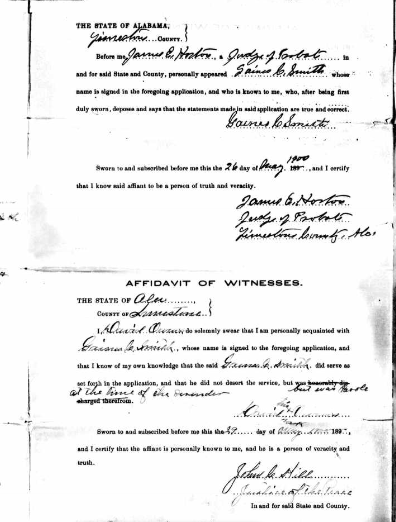
Gaines C. Smith - Civil War Pension application


Alabama Department of Archives and History; Montgomery, Alabama; Confederate Pension Applications, 1880-1940; Collection #: Microfilm in the Research Room; Roll Description: Smith, G. T. - Smith, J. A..

Gaines C. Smith - pension application


National Archives and Records Administration. U.S., Civil War Pension Index: General Index to Pension Files, 1861-1934 [database on-line]. Provo, UT, USA: Ancestry.com Operations Inc, 2000.

Thursday, May 8, 2014

Gaines Chisholm Smith - Civil War extract

Gaynes Chisholm Smith - Company H, Lt. Col., age 32, date enrolled: June 10, 1861, wounded at Gaines' Mill, Captured at Gettysburg.

Gaynes Chislom Smith - (1827-1910) would become the captain of Company H, 9th Alabama Regiment (replacing David Houston), and was later promoted to colonel of the 9th. Smith was captured at Gettysburg and later released. he was born in Giles County, Tennessee, and moved to Limestone County, where he was a farmer, a teacher, a justice of the peace, and a member of the state legislature (Krick, Lee’s Colonels 351). The privates in David Houston’s company had petitioned for Houston’s removal but were unsuccessful. Houston, however, was arrested in early September 1861 for being drunk at recitation, and that incident would lead to his resignation a month later (page 345).

William Cowan McClellan to Matilda McClellan 

Army of the Potomac
Campt Centreville. Va.
Dec 10th 1861
Dear Sister

I have just returned from one of the most heart rending scenes ever witnessed by man. I saw two men tied to a post and shot dead. They were of the far famed Tigers. Men who fought Bravely upon the plains of Manassas on the ever memorable .21. of July. The offence for which they were punished was chargeing bayonets on a Lieut(enant). They inflicted upon him two mortal wounds. They were drunk when they committed the crime. There were tried by a regular courtmartial and doomed to be shot. There were dressed in striped pants and red shirts with little red caps on their heads. All of the Tigers wore a similar dress. They were marched up in the presence of fifteen thousand men as boldly as a Tiger ever walked among a flock of sheep. They were then ordered to kneel down by the post they were tied to. The priest then prayed one of the most powerful prayers I ever heard. He pressed the cross to their lips and imprinted a kiss upon them. 12 of their own company were ordered to shoot them. When they had taken their places 10 paces in front of them, the caps were drawn over their eyes, one of them pulled it off, and said I will die looking in the muzzels of those rifles. The command was given, ready, aim, fire. Neither of them flinched until the balls had pierced their Bodys. The Priest then made a very brief and appropriate talk to the Soldiers - telling them that drinking caused the death of those men and Putting an enemy in their mouths to steal their brains away. It will have a good effect upon our army. Nothing of any importance has transpired since writeing a few days ago, some are disposed to think that the enemy have retreated to the Potomac. I believe all idea of an attack at this point has subsided. Quietness again reigns in Camp save now and then a report that is started in Camp that gains admittance into the minds of the credulous. We soldiers all rest satisfied that Beauregard and Johnston couldn’t be outgeneraled by the Feds and we can do the fighting. Gaines Smith is one of the finest looking men I ever saw every step he takes is that of a Military man every look and gesture. Smith is about 6 feet 2 inches high strait as an arrow, Gen. Johnston is also a fine looking man. Gen B. (Beauregard) has nothing very striking in his appearance save his eyes. They flash and sparkle like lightening all the time - searching to penetrate each wink upon which they rest. I frequently get invitations from these gentlemen to visit them at their head quarters. I have always declined doing so upon the plea that I am private. I suppose the caus of their partiality towards me is the close relationship I have existing between Gen. McClellan and my self. My health is tolerably good at this time. I am just getting over a very bad cold and cough. The health of our company is very good at present. Capt Smiths company are as ragged as Beauregards. The weather is very mild here at this time. I am making arrangements to get a swap to Capt Malones co, it will probably be a month or so before I can effect the change. The last letter I received from home was dated Nov. 24, except one tonight. Write soon. 

Your Brother, 
William C. McClellan Manassas Virginia


page 114

McClellan, William Cowan. Welcome the Hour of Conflict: William Cowan McClellan and the 9th Alabama. Tuscaloosa, Alabama: The University of Alabama Press, 2007.

Ninth Alabama - Infantry

Ninth Alabama - (Infantry)

This regiment was organized at Richmond, Virginia, the latter part of May 1861, and moved to Winchester several weeks later. It was there brigaded under Gen. Kirby Smith of Florida, but failed to reach the battle-field of Manassas because of a railroad accident. The regiment lay at Manassas Centerville till March 1862, when it marched to Yorktown. 

Gen. J. H. Forney of Calhoun succeeded to the command of the brigade, and was relieved by Gen. Wilcox in January. The regiment was under fire at Yorktown, with slight loss. It participated in the battle of Williamsburg, but the loss was not severe. At Seven Pines it was held in reserve, and did not suffer. It was now brigaded with the Eighth, Tenth, Eleventh, and Fourteenth Alabama regiments, still under Gen. Wilcox. At Gaines’ Mill the regiment sustained severe loss, and was rent and torn by the wall of fire at Frazier’s Farm. With the army it took up the line of March for Maryland, and was under fire but not actively engaged at the second Manassas. It was part of the investing force at Harper’s Ferry, and hastened from there to the field of Sharpsburg, where it lost 8 killed, 42 wounded, and 9 missing. The Ninth wintered on the Rappahannock, and was underfire, with few casualties, at Fredericksburg. Its brightest renown was won at Salem, where it bore the brunt of a successful assault, and lost very heavily. The regiment moved into Pennsylvania, and sustained severe loss at Gettysburg where the brigade had 781 killed and wounded. The fall and winter were passed in camp, near Orange C. H., and the Ninth participated in the fierce struggles at the Wilderness and at Appomattox, with severe loss in each battle. Gen. Sanders of Greene then took command of the brigade. The fighting was almost continuous for several weeks, culminating in the terrible repulse of the invading army at the second battle of Cold Harbor, in which the Ninth shared without severe loss. From June till the end - nine weary months - the regiment was in the trenches of Petersburg, or engaged in the majority of the numerous and bloody battles that relieved the monotony of the last, long, and desperate collision of the great rival armies that had so long struggled on Virignia soil. A remnant of the Ninth surrendered at Appomattox, the brigade having been in commond of Gen. W. H. Forney of Calhoun for some months. Of 1138 men on its rolls, about 200 fell in battle, over 175 died of disease, and 208 were discharged or transferred. 

Field and staff. 

Colonels - Cadmus M. Wilcox of Tennessee; promoted. Samuel Henry of Marshall; resigned. Horace King of Morgan; wounded at Gettsyburg. 
Lieutenant Colonels - Samuel Henry; promoted. Edward A. O’Neal of Lauderdale; transferred. Gaines Smith of Limestone. 
Majors - E. A. O’Neal; promoted. Jere Williams of Jackson; resigned. James M. Crow of Lauderdale. 
Adjutants - John Burtwell of Lauderdale; transferred. John Featherston of Limestone; transferred to line. James W. Wilson; killed at Sharpsburg. William Holcombe of Limestone; captured at Petersburg. 

CAPTAINS, AND COUNTIES FROM WHICH THE COMPANIES CAME

Mobile - F. H. Ripley; resigned. W. C. Murphy; wounded and captured at Williamsburg; killed at Salem. A. H. Hays. 

Jackson and Marshall - Jere Williams; promoted. Blake Moore; resigned. Elias Jacobs; wounded at Gettysburg; retired. Patrick Seward; captured. 

Limestone - Thomas H. Hobbs; killed at Gaines’ Mill. John Featherston; wounded at Gettysburg. 

Butler - E. Y. Hill; killed at Gaines’ Mill. Thomas Mills; resigned. Matthew Patton. 

Lauderdale - D. W. Gillis; killed at Williamsburg. John Chisholm; captured at Gettysburg; died at Fort Delaware. B. F. Taylor; wounded at Sharpsburg; captured at Petersburg. 

Lauderdale - J. Butler Houston; resigned. William C. Reeder; resigned. James M. Crow; wounded at Gaines’ Mill; promoted. Wm. J. Cannon.

Marshall - James L. Sheffield; resigned. John Rayburn; killed at Sharpsburg. A. W. Ledbetter; wounded at Salem and Petersburg. 

Lawrence - James M. Warren; resigned. M. G. May; wounded at Sharpsburg. 

Morgan - Horace King; promoted. Wm. Todd; retired. 

Limestone - David Houston; resigned. Gaines Smith; captured at Gettysburg; promoted. 


Brewster, Willis. Alabama, Her History, Resources, War Record, and Public Men: From 1540 to 1872. Montgomery, Ala: Barrett & Brown, Steam Printers and Book Binders, 1872. 

injury at Gettysburg

No. 44--(30) Mentioned by Gen. Dan Tyler, U.S. A., Maryland Heights, June 25, 1863. (288) Wilcox's brigade, Anderson's division, Third corps, Gen. A. P. Hill, army of Northern Virginia, Gettysburg, July 1-3, 1863. (332, 343) Casualties at battle of Gettysburg, 3 killed, 55 wounded. (619-621) Report of General Wilcox: "Capt. G. C. Smith, severe wound through the body (entitled to promotion to lieutenant-colonel). Capt. J. H. King (entitled to promotion to colonel) had a finger shot off. Private Brundridge severely wounded." He gives special praise to Captain King and Captain May on second day.

Taken from: http://www.civilwarhome.com/9alainf.htm


Monday, March 17, 2014

Wiley Marion Hopson - Confederate Service

Reminiscences of the Boys in Gray 1861-1865, complied by Miss Mamie Yeary, McGregor, Texas

"W.H. Hopson, Athens, Texas - born July 9, 1832, in Mereweather County, GA. Enlisted in the Confederate Army in Mississippi as a private in Frank Kimbrue's Company, Perrin Battalion. We were disbanded at Macon, GA., and attached to the Twenty-fifth Misissippi Cavalry. I was in only one skirmish on Yazoo River. Was paroled with my company at Grenada, Mississippi. 

Wiley Marion Hopson - Confederate Pension Application


Texas State Library and Archives Commission; Austin, Texas; Confederate Pension Applications, 1899-1975; Collection #: CPA16526; Roll #: 2715; Roll Description: Pension File Nos. 05461 to 05520, Application Years 1899 to 1899.

Wiley Marion Hopson - Veteran headstone application


National Archives and Records Administration; Washington, D.C.; Applications for Headstones for U.S. military veterans, 1925-1941; National Archives Microfilm Publication: M1916; Record Group Title: Records of the Office of the Quartermaster General; Record Group Number: 92.

Sunday, March 16, 2014

Saturday, December 7, 2013

James H Croney

James H Croney

birth: about 1843
location: Alabama
death: January 4, 1910
location: Texas

father: William Croney
mother: Sarah Serena Unknown

spouse: Harriet D. Smith

1850 census

1860 census

marriage - 1869

1870 census

1880 census

1900 census

burial

obit

children with Harriet D. Smith:

1. Lillian Croney
2. William Gaines Croney
3. Jesse Croney
4. Unknown Croney
5. Unknown Croney
6. Unknown Croney

Friday, October 25, 2013

Phillips Family


William R Phillips

The average American can trace their family back four generations. I traced yours back six, beginning with your great-great-great-grandfather, Isaac Phillips. He is the father of William R Phillips. document. 

According to his headstone, William R Phillips was born June 27, 1840. He died March 5, 1896. 

There are several Phillips family located in Tennessee in the middle 1800s. Too many, in fact, to positively identify this Phillips family prior to 1870. However, there is another record for William R Phillips before 1870. He served in Co. B of the 6th Tennessee Cavalry, on the Union side of the Civil War. On August 6, 1890, he filed a pension with the United States as an invalid. Then again on October 9, 1896, Sarah L filed a pension claiming widow’s benefits [1]. 


Co. B of the 6th Tennessee Cavalry was commanded by Fielding Hurst and William Jay Smith. 

“It was also known as 1st West Tennessee Cavalry. Fielding Hurst, a staunch southern Unionist during the Civil War, led the Sixth Tennessee Cavalry (USA) and proved to be one of the war’s most polarizing figures. Hurst remained committed to the Union throughout the secession crisis despite the intimidation and violence directed at Unionists by pro-secessionist forces. He courageously advocated his Unionist sentiments in a strongly worded speech before the voters. Hurst was quickly arrested and imprisoned at the state penitentiary in Nashville with other vocal Union sympathizers from across the state. The Federal occupation of Nashville eventually liberated Fielding from his confinement, and he returned home to McNairy County. 

Perhaps seeking vengeance for his arduous imprisonment, Hurst, at age fifty-one, formed a unit of mounted scouts from the “Hurst Nation” to serve with the Union Army. The Hurst scouts, although at times derided for their unsoldierly appearance by Federal officers, provided a better degree of mobility and garnered invaluable intelligence about the surrounding countryside to the Union Army as they patrolled for bands of guerillas, bushwhackers, and thieves along the Federal logistical routes. Because of their unofficial status as soldiers, it proved nearly impossible for the Union Army to properly pay or equip Hurst’s men and similar units across the state. Tennessee’s military governor, Andrew Johnson, throughout the spring of 1862 ignored frequent requests to organize these local Unionist bands formally as state regiments. A frustrated Fielding Hurst traveled to Nashville, personally confronted Johnson, and demanded a commission. Soon thereafter, Johnson named Hurst head of the First West Tennessee Cavalry (USA). With the bureaucratic logjam cleared, Hurst and other Tennessee Unionists immediately began organizing regiments, too. Confidence ran high that these local Unionists working in conjunction with Federal regiments would bring peace and order back to Tennessee.

“But for months after receiving his commission, Fielding Hurst and his new regiment languished in camp awaiting arms, rations, and other supplies from the Federal Army. More importantly, they failed to be paid for their service. Hurst’s men had to use their own money and equipment to stay in camp and risk being away from their families, who were constantly under the threat of guerilla attack. Fielding complained that the ill treatment he had received from Federal authorities had impaired his effectiveness and his recruitment of more men. Without Federal support, Hurst took matters in his own hands and began operating on his own without the sanction of the area’s commanders. He quickly earned the ire of many high-ranking officers, such as Major General Stephen Hurlbut and Major General U. S. Grant, who threatened to court-martial Hurst or disband his unit if he continued to operate independent of Federal authority.
“Hurst’s soldiers, however, were becoming extremely valuable to the Union effort in West Tennessee due to the rising guerilla attacks and Federal manpower shortage plaguing the advance on Vicksburg. Efforts were made to acquiesce to Hurst’s demands, and by November 1862, his newly designated Sixth Tennessee Cavalry (USA) scoured the vicinity of Bolivar for guerillas with notable success. Hurst’s “hard war” tactics utilized in these victories increased the level of animosity between the region’s Unionists and secessionists. For example, Hurst raided his hometown of Purdy in April 1863 and reportedly ordered the burning of the courthouse, church, and several homes. Federal officials briefly arrested Hurst for his acts at Purdy, further straining the relationship between the West Tennessee Unionists and Federal commanders.
“In July 1863, Hurst’s regiment accompanied Federal units into Jackson, Tennessee, to break up pockets of Confederate troops returning to the area. After a brief but intense battle, portions of the city lay almost completely in ruins. Criticized for their actions, the Federal units involved shifted the blame for the destruction to Hurst’s men. Fielding futilely protested the charges, and Federal commanders fined the Sixth Tennessee Cavalry (USA) over five thousand dollars from its payroll to reimburse the citizens of Jackson, many of whom were avowed secessionists.
“Hurst swore to get even with the town before the war’s end. Confederates responded by personally targeting Hurst and his family for alleged depredations against civilians and soldiers, and he once barely escaped capture by Confederate forces. Confederate guerillas tortured and executed one of Hurst’s nephews and injured Fielding’s aged sister during a night raid on her home. Hurst retaliated by capturing those believed responsible and executed five prisoners, burying them as mile markers along the Old Stage Road leading to Purdy. Such acts drew the attention of the Confederate government to Hurst’s actions in West Tennessee, and Confederate Brigadier General Nathan Bedford Forrest swore revenge on what he considered the renegade Hurst’s wartime atrocities.
“As conditions in West Tennessee deteriorated with the amplified internecine warfare, Hurst battled not only with Forrest and other guerillas but with Federal commanders who threatened to court-martial him for a growing number of complaints about his regiment’s conduct while conducting counterinsurgency operations. Nevertheless, they ordered Hurst to “grub up” West Tennessee and destroy Forrest who had returned in late 1863 to disrupt Union supply lines. As promised, Hurst subsequently returned to Jackson, set it ablaze, and proceeded to Brownsville, where he burned a sizeable number of suspected Confederate sympathizers’ homes and businesses. Forrest pursued Hurst throughout the spring of 1864 and forced the Sixth Tennessee Cavalry (USA) ignominiously back into Memphis.
“In the aftermath of Forrest’s Second West Tennessee Raid, Federal officials used Hurst and his regiment as a scapegoat for their failure to eliminate the guerilla threat and restore order in the region. Hurst, in turn, railed against the ineptitude and corruption of Federal officers, whose prejudices against Hurst’s men had impeded their effectiveness. In a stinging rebuke of his treatment by Federal authorities, Hurst told federal commander Alvin C. Gillem on June 29, 1864: “No favors have been Shown to us and no encouragement whatsoever has been extended towards us, all the Success we [have] had being attributable alone to the genuine patriotism and Self Sacrifice of the [Sixth Tennessee Cavalry]. [W]e are placed here [e]xclusively under Yankee Officers, who have no Sympathy, for a loyal Tennessean.”
“Hurst’s regiment was transferred to Middle Tennessee. On December 10, 1864, just outside of Nashville, Hurst resigned his command due to poor health. He served briefly in the Tennessee General Assembly after the war, became a circuit court judge in the Brownlow administration, and served as the local Grand Army of the Republic post.
“After the war, Hurst and his men remained a target for his mostly Confederate neighbors. Legends and stories of the Sixth Tennessee’s alleged atrocities against West Tennesseans grew over the decades, and Hurst’s name in particular was associated with nearly anything derogatory or evil. Hurst died destitute in 1882 and without any heirs, save his wife, Melocky. Even after his death, Hurst was not immune to the scorn of his detractors. They often rode over his grave on horseback and spat upon it [15].”

What I find most interesting, is that even though this Phillips family is from Southwestern Tennessee, most known for it’s Confederate sympathies, William R Phillips fought for the Union side. He’s the first Union soldier I’ve run across in at least 20 families. 

In the 1870 United States census, William R Phillips can be found in Lexington, Henderson County, Tennessee [2]. 


His family is enumerated as follows: 

Phillips, William 31 M W Farmer Tennessee
Sarah L 26 F W Keeping House Tennessee
Sarah E 2 F W Tennessee
Isaac 75 M W North Carolina

William Phillips’ value of real estate is $500 and his personal estate is valued at $300. This census also lists whether citizens are able to read and write; William, Sarah L and Isaac can all read and write [3]. 

In 1880, the family is in the same location. 

They are enumerated as follows: 

Phillips William R W M 37 Farmer Tennessee
Sarah L W F 35 wife Keeps House Tennessee
Sarah E W F 11 daughter Tennessee
Martha J W F 9 daughter Tennessee
Cintha E W F 6 daughter Tennessee
William A W M 4 son Tennessee
Walter L W M 2 son Tennessee
John J W M 28 nephew work on farm Tennessee
Isaac W M 75 father boarder North Carolina

I believe the Isaac enumerated in both the 1870 census and 1880 census is the same person, and the father of William R Phillips, even though Isaac Phillips’ age stays the same after ten years. Interestingly, there is another William R Phillips enumerated just below your William R Phillips family. Both Williams are close in age, born in Tennessee, and both sets of parents are born in North Carolina. Most likely they are cousins and the bottom William R Phillips is a brother to John J Phillips. 

In 1890 the family was in Texas. William R Phillips filed his invalid status pension application from there. He is buried in Rose Hill Cemetery, Merkel, Taylor County, Texas [4]. 


Sarah L Phillips is found in the 1900 United States census in Jones County, Texas [5]. 
Enumerated in the household are: 

Phillips S. L. head W F Nov 1843 56 Wd Tennessee
  1. A. son W M July 1876 23 S Tennessee
  2. L. son W M Apr  1879 21 S Tennessee
  1. S. grandson W M Nov 1894 5 S Texas

Sarah L Phillips is listed as the mother of 6 children, 6 living. She is engaged in farming. 

In 1910, Sarah L Phillips is still living in Jones County, Texas [6]. 


Enumerated are the following:

Phillips, Sarah L head F W 68 W Tennessee
Walter L son M W 30 W Tennessee
Vera granddaughter F W 8 S Texas
Anna L granddaughter F W 6 S Texas
Georgia granddaughter F W 4 S Texas
Sinclair grandson M W 15 S Texas

Sarah L Phillips is listed as the mother of 6 children, 6 living. She is a farmer on a general farm. 

In the 1920 census, Sarah L Phillips is living alone, but next door to her daughter, Cyntha Ellen Phillips Winter [7]. 


Again in 1930, Sarah L Phillips is enumerated alone as head of household. She is living next door to son, Walter L. Phillips, and he next door to his daughter, Anna L Phillips Truitt [8]. 


Sarah L Phillips’ home is valued at $5,000. She was 17 at her first marriage. This means she married William R Phillips in 1860. 

Even though alive in 1940, I can not find her in the census records. The next record I find for Sarah is her death certificate. 


Sarah L Phillips is buried next to William R Phillips in Rose Hill Cemetery, Merkel, Taylor County, Texas. 

According to the death certificate of her daughter, Cyntha Ellen Winter, Sarah’s full name was Sarah Lou Viteto Phillips [9]. 

The death certificate of Sarah L Phillips’ son, William Atlas Phillips, also backs up the maiden name of Viteto [10]. 


Unknown Father of Charles Sinclair Phillips

missing generation

Charles Sinclair Phillips

Charles Sinclair Phillips was born November 28, 1894 in Texas. He died on November 26, 1977. He first appears in the United States census in 1900, enumerated in the household of his grandmother, Sarah L Phillips [5]. 

Also, in the 1910 census, Charles Sinclair Phillips is enumerated with his grandmother [6]. 


Charles Sinclair Phillips is the grandson of William R and Sarah L Phillips. I can find no record of who his parents were. The 1890 census would probably provide this information, but almost of of the 1890 census returns burned in a fire in 1921. I am inclined to believe that they died young, since Charles Sinclair Phillips is found living with his grandmother beginning at least when he was 6 years old. 

Charles Sinclair Phillips registered for the WW I draft [13]. 


By the 1920, Charles Sinclair Phillips has started his own family, in Jones County, Texas [11]. 

Enumerated are: 

Phillips, Charles S head M W 25 M Texas
Rachel B wife F W 25 M Arkansas
William H son M W 6/12 S Texas

Charles Sinclair Phillips’ occupation is listed at farmer on a general farm. (Notice the last name of the family living next door; Howell.)

The 1930 census has Charles Sinclair and family living in Big Lake, Reagan County, Texas [12]. 

Listed in the household are the following: 

Phillips, Charley head M W 35 M Texas
Rachel wife F W 35 M Arkansas
W H son M W 14 S Texas
Wilma daughter F W 10 S Texas
Iva Lou daughter F W 1 11/12 S Texas

Charles Sinclair Phillips owns his own home, valued at $2,100. He was age 18 when first married. His occupation is meat cutter in a meat market. 

I can not find Charles Sinclair Phillips and family in the 1940 census. The next record I found was his World War II draft card [14]. 


Charles Sinclair Phillips died on November 26, 1977. He is buried in Rose Hill Cemetery, Merkle, Taylor County, Texas. 

Rachel B Phillips died on August 24, 1990. She shares a headstone with her husband. 

I can’t find ANYTHING on William Howell Phillips other than his census enumeration with his parents. Not even a death record. 


1 General Index to Pension Files, 1861-1934. Washington, D.C.: National Archives and Records Administration. T288, 546 rolls.

2 "United States Census, 1870," index and images, FamilySearch (https://familysearch.org/pal:/MM9.1.1/MDD7-GTF : accessed 24 Oct 2013), Sarah E Phillips in household of William Phillips, Tennessee, United States; citing p. 20, family 123, NARA microfilm publication M593, FHL microfilm 553036.

3 "United States Census, 1880," index and images, FamilySearch (https://familysearch.org/pal:/MM9.1.1/MD7F-D1S : accessed 24 Oct 2013), Wm. R. Phillips, District 11, Henderson, Tennessee, United States; citing sheet 404C, family 0, NARA microfilm publication T9-1262

4 Findagrave.com

5 "United States Census, 1900," index and images, FamilySearch (https://familysearch.org/pal:/MM9.1.1/M3P3-GHD : accessed 24 Oct 2013), S L Phillips, ED 101 Justice Precincts 4 -5, Jones, Texas, United States; citing sheet 6B, family 101, NARA microfilm publication T623, FHL microfilm 1241650.

6 "United States Census, 1910," index and images, FamilySearch (https://familysearch.org/pal:/MM9.1.1/M23G-8J9 : accessed 24 Oct 2013), Sarah L Phillips, Justice Precinct 4, Jones, Texas, United States; citing sheet , family 361, NARA microfilm publication T624, FHL microfilm 1375582.

7 "United States Census, 1920," index and images, FamilySearch (https://familysearch.org/pal:/MM9.1.1/MC9D-BHL : accessed 24 Oct 2013), Sarah G Phillips, Justice Precinct 4, Jones, Texas, United States; citing sheet , family 96, NARA microfilm publication T625, FHL microfilm 1821824.

8 "United States Census, 1930," index and images, FamilySearch (https://familysearch.org/pal:/MM9.1.1/CSCL-M3Z : accessed 24 Oct 2013), Sarah L Phillips, Precinct 4, Jones, Texas, United States; citing enumeration district (ED) 0011, sheet , family 272, NARA microfilm publication .

9 "Texas, Deaths, 1890-1976," index and images, FamilySearch (https://familysearch.org/pal:/MM9.1.1/K379-F3F : accessed 24 Oct 2013), Sarah Lori Veteto in entry for Synthe Ellen Winter, 23 Feb 1956; citing certificate number 10362, State Registrar Office, Austin; FHL microfilm 2114628.

10 "Texas, Deaths, 1890-1976," index and images, FamilySearch (https://familysearch.org/pal:/MM9.1.1/K34C-RHC : accessed 24 Oct 2013), Sarah Lou Veteto in entry for William Atlas Phillips, 18 Mar 1959; citing certificate number 17577, State Registrar Office, Austin; FHL microfilm 2115909.

11 "United States Census, 1920," index and images, FamilySearch (https://familysearch.org/pal:/MM9.1.1/MC96-B9L : accessed 24 Oct 2013), Charles S Phillips, Justice Precinct 4, Jones, Texas, United States; citing sheet , family 79, NARA microfilm publication T625, FHL microfilm 1821824.

12 "United States Census, 1930," index and images, FamilySearch (https://familysearch.org/pal:/MM9.1.1/HJM7-PW2 : accessed 24 Oct 2013), Rachel Phillips in household of Charley Phillips, Big Lake, Reagan, Texas, United States; citing enumeration district (ED) 0002, sheet , family 135, NARA microfilm publication .

13 "United States World War I Draft Registration Cards, 1917-1918," index and images, FamilySearch (https://familysearch.org/pal:/MM9.1.1/KZXV-3XD : accessed 24 Oct 2013), Charley Sinclair Phillips, 1917-1918; citing Jones County, Texas, United States, NARA microfilm publication M1509, (Washington D.C.: National Archives and Records Administration, n.d); FHL microfilm 1983267.

14 "United States World War II Draft Registration Cards, 1942," index and images, FamilySearch (https://familysearch.org/pal:/MM9.1.1/XPP7-KJW : accessed 24 Oct 2013), Charles Sinclair Phillips, 1942.

15 Frisby, Derek W. "Fielding Hurst (1810-1882)." Fielding Hurst. Middle Tennessee State University, 04 Jan. 2010. Web. 24 Oct. 2013. <http://tennesseeencyclopedia.net/entry.php?rec=1616>.