 |
Saturday, May 31, 2014


Kidd Brothers
before 1966
kneeling: Jack Kidd
standing: Holland Kidd, Elton Kidd, Neal Kidd, Verdon Kidd, and Coleman "Buster" Kidd

kneeling: Jack Kidd
standing: Holland Kidd, Elton Kidd, Neal Kidd, Verdon Kidd, and Coleman "Buster" Kidd
Juanita Kidd Hardwick

birth: November 15, 1915
location: Henderson County, Texas
death: June 9, 2006
location:
father: Coleman Kidd
mother: Minnie Lee Clayton
spouse: Russell O Hardwick
1920 census
1930 census
marriage to Russell O Hardwick
1940 census
burial
children with Russell O Hardwick:
Sherry Ann Hardwick - 1936
Gary Don Hardwick - 1938

42 at Mimi's
42 game at Mimi's house. Left to right: Era Maude Kidd Welch, Verdon Kidd, Wendell Welch, Ima Dell and Neal Kidd.
I remember the fruit hanging on the wall.

©JaycieSmith
I remember the fruit hanging on the wall.

Saturday, May 24, 2014
Jas A M Davis - 1900 census
1900 census
location: Ballinger, Runnels County, Texas
date: June 11, 1900
Jas A M Davis head white male Oct 1832 67 widow Alabama capitalist

"United States Census, 1900," index and images, FamilySearch (https://familysearch.org/pal:/MM9.1.1/M35Q-C3X : accessed 25 May 2014), Jas A M Davis, Justice Precinct 1 Ballinger town, Runnels, Texas, United States; citing sheet 11B, family 211, NARA microfilm publication T623, FHL microfilm 1241667.
James Anderson "Andy" Munroe Davis
birth: July 1833
location: Alabama
death: January 13, 1913
location: Scurry County, Texas
location: Scurry County, Texas
father:
mother:
spouse: Malissa Jane Castellaw
marriage to Malissa Jane Castellaw - 1858
1860 census
came to Texas - 1867
marriage to Malissa Jane Castellaw - 1858
1860 census
came to Texas - 1867
children with Malissa J Castellaw:
John Victor Davis - 1859
Julia Pearl Davis - 1871
Lucy Carrie Davis - 1873
Margaret Amanda Davis - 1875
Felix Monroe Davis - 1878
Edna Davis - 1883
Lucy Carrie Davis - 1873
Margaret Amanda Davis - 1875
Felix Monroe Davis - 1878
Edna Davis - 1883
James M Davis - 1870 census
1870 census
location: Fincastle, Henderson County, Texas
date: August 31, 1870
Jas M Davis 37 male white farmer value of real estate: $300 value of personal estate: $400 Alabama
Malissa J Davis 23 female white keeping house Alabama
John V Davis 11 male white Alabama
Eliza V Davis 4 female white Alabama
Mary Davis 1 female white Texas

"United States Census, 1870," index and images, FamilySearch (https://familysearch.org/pal:/MM9.1.1/MXLB-2N1 : accessed 25 May 2014), Eliza V Davis in household of Jas M Davis, Texas, United States; citing p. 39, family 281, NARA microfilm publication M593, FHL microfilm 000553090.
Julia McKay death

"Texas, Deaths, 1890-1976," index and images, FamilySearch (https://familysearch.org/pal:/MM9.1.1/K3H1-5RC : accessed 25 May 2014), Julia Mckay, 02 Mar 1937; citing certificate number 17807, State Registrar Office, Austin; FHL microfilm 2117171.
Andy Davis - 1880 census
1880 census
location: Fincastle, Henderson County, Texas
date: June 21, 1880
J A M Davis white male 46 married farmer Alabama
Mallissa J Davis white female 39 wife married keeping house Alabama
John V Davis white male 21 son single works on farm Alabama
Eliza V Davis white female 14 daughter single at house Alabama
Mary L Davis white female 10 daughter single at house Texas
Julia P Davis white female 8 daughter single at house Texas
Lucy C Davis white female 7 daughter single at house Texas
Maggie Davis white female 5 daughter single at house Texas
Munroe Davis white male 2 son single at house Texas

"United States Census, 1880," index and images, FamilySearch (https://familysearch.org/pal:/MM9.1.1/MFNK-39W : accessed 25 May 2014), Julia P Davis in household of J A M Davis, Fincastle, Henderson, Texas, United States; citing sheet 197C, NARA microfilm publication T9.
Julie Pearl Davis Hopson McKay
Julie Pearl Davis Hopson McKay
birth: April 23, 1871
location: Henderson County, Texas
death: March 21, 1937
location: Smith County, Texas
father: James Anderson "Andy" Munroe Davis
mother: Malissa
spouse: William H. Hopson
spouse: Henry McKay
1880 census
marriage to William H. Hopson
1900 census
photo with William H. Hopson
1910 census
death
burial
children with William H. Hopson:
Ida Hopson
Ella Mae Hopson
Tina Lee Hopson
Jim Hopson
Riley Hopson
Henry Hopson
Walter Hopson
Willie Hopson
Elmer Hopson
Friday, May 23, 2014
History 5373 - Civil War and Reconstruction
History 5373 - Civil War and Reconstruction
Summer I - 2014
Blight, David W. Race and Reunion: The Civil War in American Memory. Cambridge: Belknap Press, 2001.
Book Review
Before the American Civil War even ended people looked for meaning in the dead and the living. David W. Blight’s Race and Reunion: The Civil War in American Memory provides readers with three leading memories of the Civil War: (1) the reconciliationist vision that extolled the dedication of Union and Confederate soldiers without entertaining discourse on the causes and motives of the Civil War, (2) the white supremacist vision that would minimize the role of race and slavery as a cause of the war and justification of the South’s social order before the war, and (3) the emancipationist remembrance that struggled to provide the rebirth of the nation with black citizenship and black equality. These three visions would propel Americans out of the Civil War and Reconstruction years to well into the nineteenth century.
Blight relies heavily on poet Walt Whitman for the root of reconciliationist thought and ideology. Serving the wounded and dying of both armies, Whitman became the epitome of the sectional reconciler: understanding of soldiers’ death and their need to mourn, commemorate, and memorialize all the death on both sides.(1) In fact, Blight credits Whitman with building and illuminating “the literary avenue to reunion.”(2) After the Civil War many Americans wanted to forget the Civil War and its causes. Sectional reconciliation would allow both the North and South to come together and rebuild the nation. Just days after the surrender at Appomattox the first mutual ceremony involving a parade and the decoration of the graves of the dead with spring flowers took place. (3) What was known then as ‘Decoration Day,’ would later become known as Memorial Day, spread throughout the North and South as a way to mutually sympathize and respect the dead of both sides. (4) Veterans themselves also needed a way to recollect and reunite. With a wave of fraternalism, soldiers’ reunions became a way for veterans to reminisce and express their shared trauma. These aging veterans were able to reconcile themselves together through commemoration of a common valor shared in the Civil War.
Even with themes of reconciliation abounding in American culture and literature, Blight maintains that the white supremacist vision of the Civil War and Reconstruction took the place of the reconcilationist vision, especially in the South. In the beginning, Southerners had begun to remember the Civil War as the Lost Cause. The Lost Cause was the voice of reconciliation, but equally demeaned blacks, and crushed black adult’s rights. (5) The three elements that maintained prominence in the Lost Cause were the movement’s effort to write and control history, its use of white supremacy, and the place of women in its development. (6) And so, what began as a white counterrevolution during Reconstruction became the genesis of the Ku Klux Klan in 1866. (7) The Lost Cause developed into the South’s narrative of racial victory. (8) Specifically using the literary works of Thomas Nelson Page, Blight proves his point about the white supremacist vision. Because of Page’s fiction that depicted the plantation legend and agrarian virtue, he became a literary superstar for the South.(9) Undoubtedly, one of the most racially biased figures Blight utilizes as an example of white supremacy and black hatred is Mildred Lewis Rutherford of Athens, Georgia. As historian general of the United Daughters of the Confederacy, Rutherford was able to collect a massive library of the racist underworld and Lost Cause ideology. With essays, photographs and postcards, Rutherford filled scrapbooks with examples of lynchings, ‘loyal’ ex-slaves and Klansmen. (10) The white supremacist vision took deep root in the South, eventually leading to the Jim Crow era of Southern society and becoming ground zero for the Civil Rights Movement in the 1960s.
According to Blight, lingering in the background of both the reconciliationist and white supremacist visions stood the emancipationist remembrance of the Civil War and Reconstruction. Led by abolitionists like Frederick Douglass, the narrative of black Civil War memory was of a national rebirth and redefinition. (11) In a lengthy chapter, “Black Memory and Progress of the Race,” Blight cites Booker T. Washington as leading the rhetoric on the “progress of the race” and the race problem. (12) Washington’s “progress of the race” theory viewed the beginning of of Negro life in America as the end of slavery, along with blacks emerging from slavery as a Christian people. (13) Washington pushed an “accommodationism” society, where blacks should demonstrate gratitude for past lives laid down and sacrifices made. (14) Blight goes on to paint Washington as the ultimate apologizer for the black race, both for their color and inability to live up to standards set by whites. Emancipationism fused the rebirth and redefinition led by Douglass and the accommodationism vision led by Washington.
As the 50th anniversary of the Civil War loomed, Americans had seen economic and social change, along with sectional reconciliation. (15) At the supremely segregated reunion at Gettysburg in 1913, Blight points out that whites took the memory of the Civil War and Reconstruction from blacks, leaving blacks as outsiders looking in - a trend that would continue throughout the nineteenth century. (16)
Blight’s use of contemporary literature and resources is impressive; however, Race and Reunion is not easy to read, in part because of the frequent borrowing from other sources. Blight could have had a greater eye for detail, as in his frequent omission of a closing parenthesis. Even more detracting is the transposition of the abbreviation for the Son’s of Confederate Veterans as SVC instead of SCV. (17) Other than Presidential elections in the two decades following the Civil War does Blight reference the political climate. Perhaps anticipating such criticism, Blight points out in his prologue that he does put considerable attention on Reconstruction politics while leaving out “late-nineteenth-century presidential politics.” (18) This omission of nineteenth century political climate by Blight leaves much unsaid for the plight of African-Americans into the nineteenth century.
As the Director of the Gilder Lehrman Center for the Study of Slavery, Resistance and Abolition at Yale and Professor of History at Yale University, David W. Blight is a leading expert on the Civil War and Reconstruction era. Race and Reunion received many book awards, including the Bancroft Prize, the Abraham Lincoln Prize, and the Frederick Douglass Prize. (19)
As the Director of the Gilder Lehrman Center for the Study of Slavery, Resistance and Abolition at Yale and Professor of History at Yale University, David W. Blight is a leading expert on the Civil War and Reconstruction era. Race and Reunion received many book awards, including the Bancroft Prize, the Abraham Lincoln Prize, and the Frederick Douglass Prize. (19)
1 David W. Blight, Race and Reunion: The Civil War in American Memory. (Cambridge: Belknap Press, 2001), 23.
2 Blight, Race and Reunion, 20.
3 Blight, Race and Reunion, 65.
4 Blight, Race and Reunion, 84.
5 Blight, Race and Reunion, 272.
6 Blight, Race and Reunion, 259.
7 Blight, Race and Reunion, 112.
8 Blight, Race and Reunion, 291.
9 Blight, Race and Reunion, 225.
10 Blight, Race and Reunion, 289-290.
11 Blight, Race and Reunion, 303.
12 Blight, Race and Reunion, 300.
13 Blight, Race and Reunion, 320.
14 Blight, Race and Reunion, 348.
15 Blight, Race and Reunion, 359.
16 Blight, Race and Reunion, 366.
17 Blight, Race and Reunion, 272.
18 Blight, Race and Reunion, 2.
19 Yale University Department of History. “David Blight.” accessed May 19, 2014, history.yale.edu/people/david-blight.
19 Yale University Department of History. “David Blight.” accessed May 19, 2014, history.yale.edu/people/david-blight.
Thursday, May 15, 2014
Gaines C. Smith - Civil War Pension application


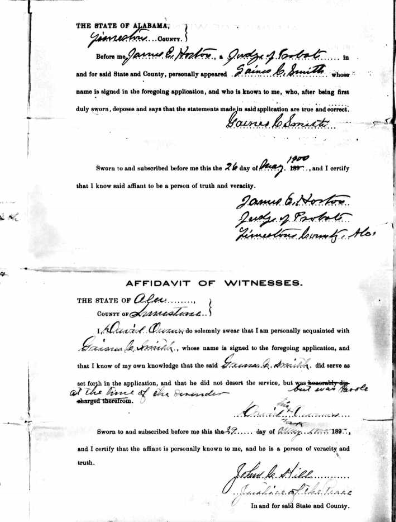


Alabama Department of Archives and History; Montgomery, Alabama; Confederate Pension Applications, 1880-1940; Collection #: Microfilm in the Research Room; Roll Description: Smith, G. T. - Smith, J. A..
Gaines C. Smith - pension application

National Archives and Records Administration. U.S., Civil War Pension Index: General Index to Pension Files, 1861-1934 [database on-line]. Provo, UT, USA: Ancestry.com Operations Inc, 2000.
Gaines C. Smith: Mexican-American War service
name: Smith Gaines C.
age at enlistment: 20
eye color: black
hair color: black
complexion: dark
height: 5'9
birth state: Tennessee
birth county: Giles
occupation: schoolmaster
enlistment: August 10, 1847
where: Athens
by whom: Capt. Jones
discharged: July 15, 1848
cause of discharge: exp. of service
where: Mobile, Alabama


Friday, May 9, 2014
William Smith
birth: about 1760
location:
death: about 1836
location:
father:
mother:
spouse:
children:
Briant Smith
Edith Smith
Samuel Smith
Mary Smith
Phelps Smith
location:
death: about 1836
location:
father:
mother:
spouse:
children:
Briant Smith
Edith Smith
Samuel Smith
Mary Smith
Phelps Smith
Phelps Smith
birth:
location:
death:
location:
father: William Smith
mother:
spouse: Elizabeth
1820 census
1830 census
children with Elizabeth:
Gaines Chisholm Smith
Aroma Catherine Smith
location:
death:
location:
father: William Smith
mother:
spouse: Elizabeth
1820 census
1830 census
children with Elizabeth:
Gaines Chisholm Smith
Aroma Catherine Smith
Thursday, May 8, 2014
Gaines Chisholm Smith - Civil War extract
Gaynes Chisholm Smith - Company H, Lt. Col., age 32, date enrolled: June 10, 1861, wounded at Gaines' Mill, Captured at Gettysburg.
McClellan, William Cowan. Welcome the Hour of Conflict: William Cowan McClellan and the 9th Alabama. Tuscaloosa, Alabama: The University of Alabama Press, 2007.
Gaynes Chislom Smith - (1827-1910) would become the captain of Company H, 9th Alabama Regiment (replacing David Houston), and was later promoted to colonel of the 9th. Smith was captured at Gettysburg and later released. he was born in Giles County, Tennessee, and moved to Limestone County, where he was a farmer, a teacher, a justice of the peace, and a member of the state legislature (Krick, Lee’s Colonels 351). The privates in David Houston’s company had petitioned for Houston’s removal but were unsuccessful. Houston, however, was arrested in early September 1861 for being drunk at recitation, and that incident would lead to his resignation a month later (page 345).
William Cowan McClellan to Matilda McClellan
Army of the Potomac
Campt Centreville. Va.
Dec 10th 1861
Dear Sister
I have just returned from one of the most heart rending scenes ever witnessed by man. I saw two men tied to a post and shot dead. They were of the far famed Tigers. Men who fought Bravely upon the plains of Manassas on the ever memorable .21. of July. The offence for which they were punished was chargeing bayonets on a Lieut(enant). They inflicted upon him two mortal wounds. They were drunk when they committed the crime. There were tried by a regular courtmartial and doomed to be shot. There were dressed in striped pants and red shirts with little red caps on their heads. All of the Tigers wore a similar dress. They were marched up in the presence of fifteen thousand men as boldly as a Tiger ever walked among a flock of sheep. They were then ordered to kneel down by the post they were tied to. The priest then prayed one of the most powerful prayers I ever heard. He pressed the cross to their lips and imprinted a kiss upon them. 12 of their own company were ordered to shoot them. When they had taken their places 10 paces in front of them, the caps were drawn over their eyes, one of them pulled it off, and said I will die looking in the muzzels of those rifles. The command was given, ready, aim, fire. Neither of them flinched until the balls had pierced their Bodys. The Priest then made a very brief and appropriate talk to the Soldiers - telling them that drinking caused the death of those men and Putting an enemy in their mouths to steal their brains away. It will have a good effect upon our army. Nothing of any importance has transpired since writeing a few days ago, some are disposed to think that the enemy have retreated to the Potomac. I believe all idea of an attack at this point has subsided. Quietness again reigns in Camp save now and then a report that is started in Camp that gains admittance into the minds of the credulous. We soldiers all rest satisfied that Beauregard and Johnston couldn’t be outgeneraled by the Feds and we can do the fighting. Gaines Smith is one of the finest looking men I ever saw every step he takes is that of a Military man every look and gesture. Smith is about 6 feet 2 inches high strait as an arrow, Gen. Johnston is also a fine looking man. Gen B. (Beauregard) has nothing very striking in his appearance save his eyes. They flash and sparkle like lightening all the time - searching to penetrate each wink upon which they rest. I frequently get invitations from these gentlemen to visit them at their head quarters. I have always declined doing so upon the plea that I am private. I suppose the caus of their partiality towards me is the close relationship I have existing between Gen. McClellan and my self. My health is tolerably good at this time. I am just getting over a very bad cold and cough. The health of our company is very good at present. Capt Smiths company are as ragged as Beauregards. The weather is very mild here at this time. I am making arrangements to get a swap to Capt Malones co, it will probably be a month or so before I can effect the change. The last letter I received from home was dated Nov. 24, except one tonight. Write soon.
Your Brother,
William C. McClellan Manassas Virginia
page 114
McClellan, William Cowan. Welcome the Hour of Conflict: William Cowan McClellan and the 9th Alabama. Tuscaloosa, Alabama: The University of Alabama Press, 2007.
Ninth Alabama - Infantry
Ninth Alabama - (Infantry)
This regiment was organized at Richmond, Virginia, the latter part of May 1861, and moved to Winchester several weeks later. It was there brigaded under Gen. Kirby Smith of Florida, but failed to reach the battle-field of Manassas because of a railroad accident. The regiment lay at Manassas Centerville till March 1862, when it marched to Yorktown.
Gen. J. H. Forney of Calhoun succeeded to the command of the brigade, and was relieved by Gen. Wilcox in January. The regiment was under fire at Yorktown, with slight loss. It participated in the battle of Williamsburg, but the loss was not severe. At Seven Pines it was held in reserve, and did not suffer. It was now brigaded with the Eighth, Tenth, Eleventh, and Fourteenth Alabama regiments, still under Gen. Wilcox. At Gaines’ Mill the regiment sustained severe loss, and was rent and torn by the wall of fire at Frazier’s Farm. With the army it took up the line of March for Maryland, and was under fire but not actively engaged at the second Manassas. It was part of the investing force at Harper’s Ferry, and hastened from there to the field of Sharpsburg, where it lost 8 killed, 42 wounded, and 9 missing. The Ninth wintered on the Rappahannock, and was underfire, with few casualties, at Fredericksburg. Its brightest renown was won at Salem, where it bore the brunt of a successful assault, and lost very heavily. The regiment moved into Pennsylvania, and sustained severe loss at Gettysburg where the brigade had 781 killed and wounded. The fall and winter were passed in camp, near Orange C. H., and the Ninth participated in the fierce struggles at the Wilderness and at Appomattox, with severe loss in each battle. Gen. Sanders of Greene then took command of the brigade. The fighting was almost continuous for several weeks, culminating in the terrible repulse of the invading army at the second battle of Cold Harbor, in which the Ninth shared without severe loss. From June till the end - nine weary months - the regiment was in the trenches of Petersburg, or engaged in the majority of the numerous and bloody battles that relieved the monotony of the last, long, and desperate collision of the great rival armies that had so long struggled on Virignia soil. A remnant of the Ninth surrendered at Appomattox, the brigade having been in commond of Gen. W. H. Forney of Calhoun for some months. Of 1138 men on its rolls, about 200 fell in battle, over 175 died of disease, and 208 were discharged or transferred.
Field and staff.
Colonels - Cadmus M. Wilcox of Tennessee; promoted. Samuel Henry of Marshall; resigned. Horace King of Morgan; wounded at Gettsyburg.
Lieutenant Colonels - Samuel Henry; promoted. Edward A. O’Neal of Lauderdale; transferred. Gaines Smith of Limestone.
Majors - E. A. O’Neal; promoted. Jere Williams of Jackson; resigned. James M. Crow of Lauderdale.
Adjutants - John Burtwell of Lauderdale; transferred. John Featherston of Limestone; transferred to line. James W. Wilson; killed at Sharpsburg. William Holcombe of Limestone; captured at Petersburg.
CAPTAINS, AND COUNTIES FROM WHICH THE COMPANIES CAME
Mobile - F. H. Ripley; resigned. W. C. Murphy; wounded and captured at Williamsburg; killed at Salem. A. H. Hays.
Jackson and Marshall - Jere Williams; promoted. Blake Moore; resigned. Elias Jacobs; wounded at Gettysburg; retired. Patrick Seward; captured.
Limestone - Thomas H. Hobbs; killed at Gaines’ Mill. John Featherston; wounded at Gettysburg.
Butler - E. Y. Hill; killed at Gaines’ Mill. Thomas Mills; resigned. Matthew Patton.
Lauderdale - D. W. Gillis; killed at Williamsburg. John Chisholm; captured at Gettysburg; died at Fort Delaware. B. F. Taylor; wounded at Sharpsburg; captured at Petersburg.
Lauderdale - J. Butler Houston; resigned. William C. Reeder; resigned. James M. Crow; wounded at Gaines’ Mill; promoted. Wm. J. Cannon.
Marshall - James L. Sheffield; resigned. John Rayburn; killed at Sharpsburg. A. W. Ledbetter; wounded at Salem and Petersburg.
Lawrence - James M. Warren; resigned. M. G. May; wounded at Sharpsburg.
Morgan - Horace King; promoted. Wm. Todd; retired.
Limestone - David Houston; resigned. Gaines Smith; captured at Gettysburg; promoted.
Brewster, Willis. Alabama, Her History, Resources, War Record, and Public Men: From 1540 to 1872. Montgomery, Ala: Barrett & Brown, Steam Printers and Book Binders, 1872.
injury at Gettysburg
No. 44--(30) Mentioned by Gen. Dan Tyler, U.S. A., Maryland Heights, June 25, 1863. (288) Wilcox's brigade, Anderson's division, Third corps, Gen. A. P. Hill, army of Northern Virginia, Gettysburg, July 1-3, 1863. (332, 343) Casualties at battle of Gettysburg, 3 killed, 55 wounded. (619-621) Report of General Wilcox: "Capt. G. C. Smith, severe wound through the body (entitled to promotion to lieutenant-colonel). Capt. J. H. King (entitled to promotion to colonel) had a finger shot off. Private Brundridge severely wounded." He gives special praise to Captain King and Captain May on second day.
Taken from: http://www.civilwarhome.com/9alainf.htm
Taken from: http://www.civilwarhome.com/9alainf.htm
Friday, May 2, 2014
John David German Adrian - 1870 census
1870 census
location: Garden Valley, Van Zandt County, Texas
date: August 11, 1870
John Adrin 55 male white farmer value of real estate: $600 value of personal estate $520 Georgia
John C Adrin 18 male white farm labor Texas
King Adrin 16 male white farm labor Texas
Buchanan Adrin 15 male white Texas
Andew Adrin 11 male white Texas


Year: 1870; Census Place: Garden Valley Beat, Smith, Texas; Roll: M593_1605; Page: 320B; Image: 244; Family History Library Film: 553104.
Subscribe to:
Posts (Atom)